Product

Autonomous agents for
hardware-aware kernel
optimization.

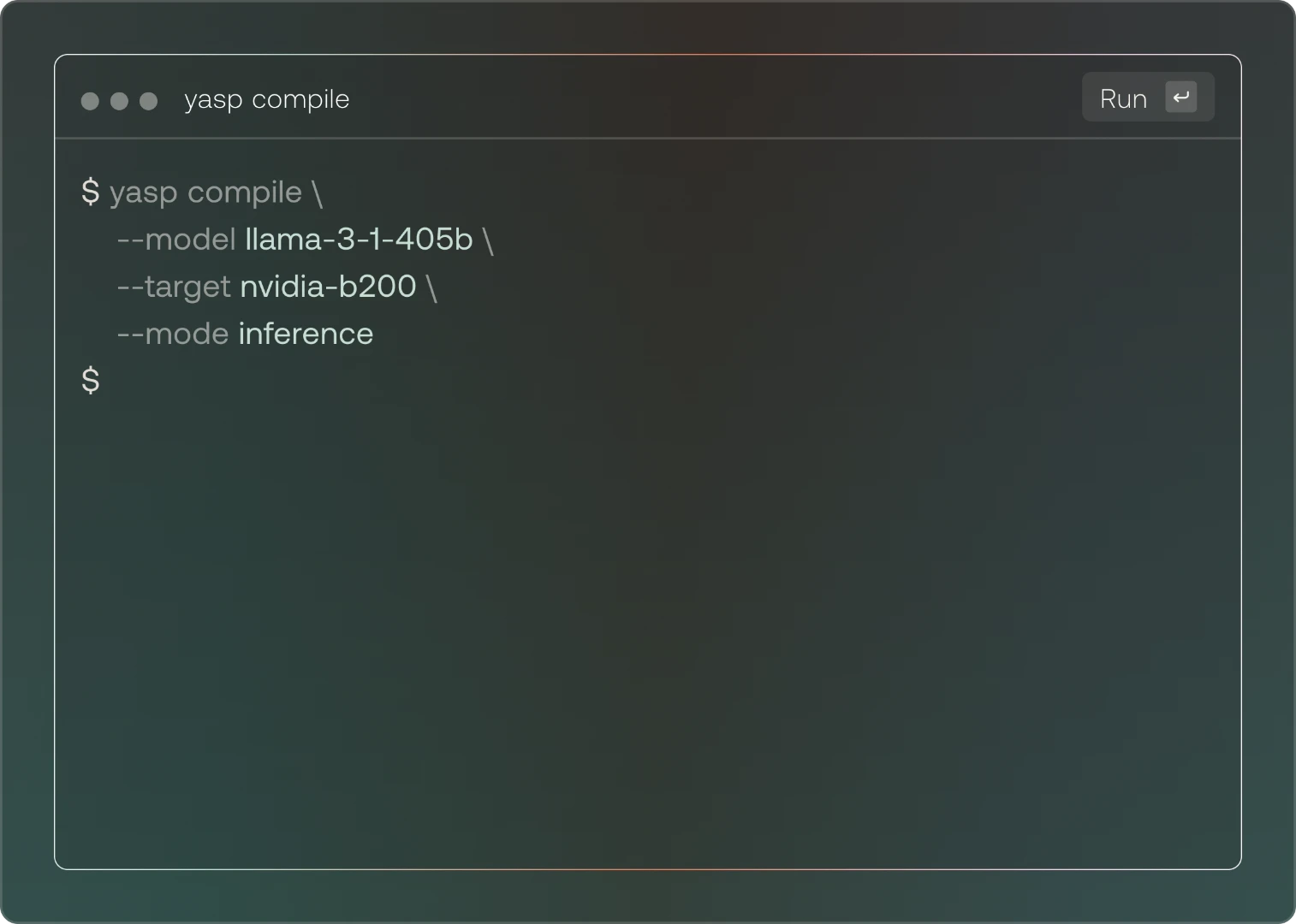
yasp's agents profile your model on real silicon, generate optimized kernels for the target hardware, and validate every result. Faster models. More silicon options. Less time between research and production.
Book a Meeting
Book a Meeting
Read the Docs
Read the Docs
Surfaces

An assistant, a kernel engine, a
binary builder, and a shared memory.

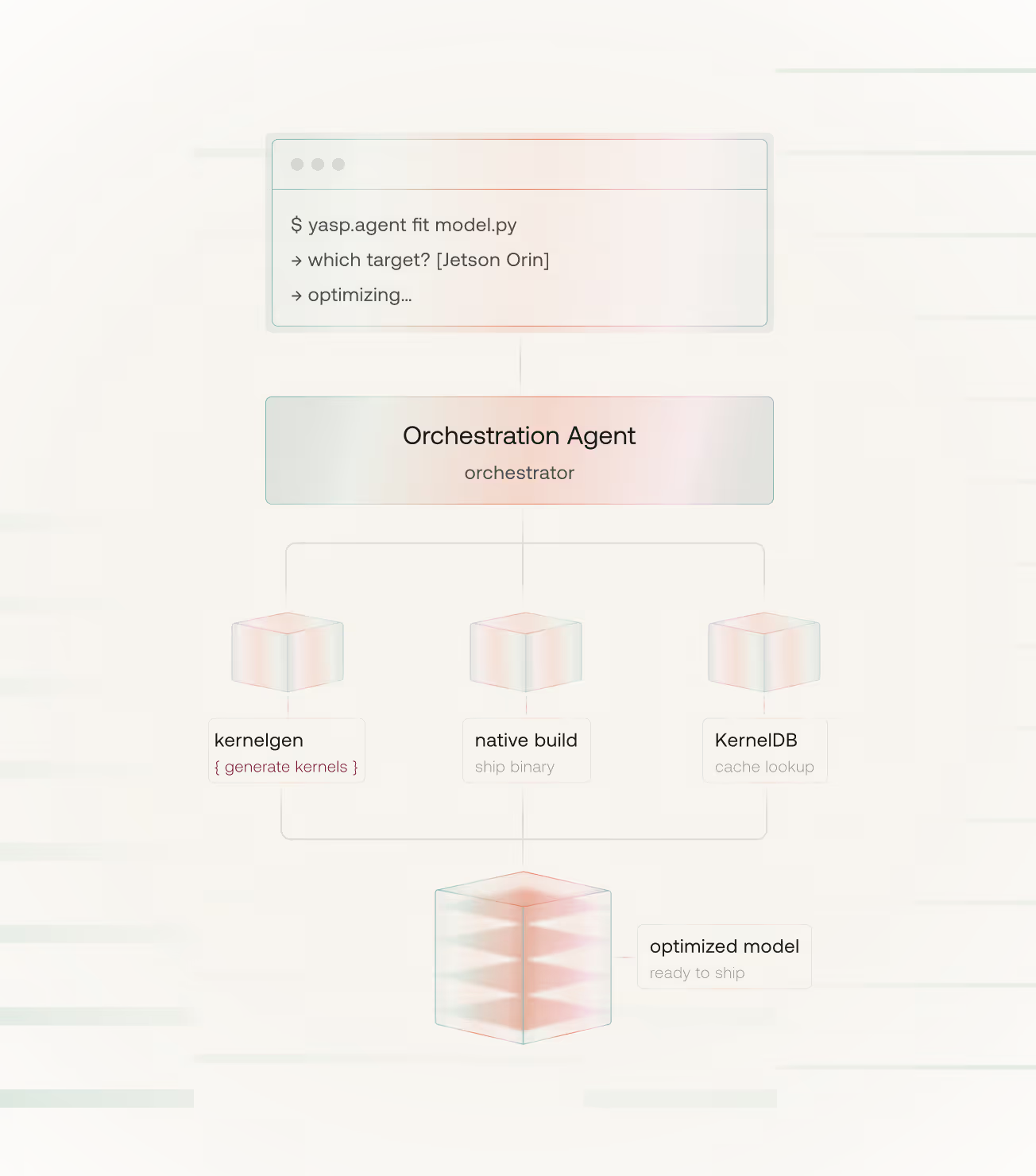
One workflow. The assistant orchestrates. The engine generates.
The builder ships. The memory remembers.

Kronos

From PyTorch to optimized output, conversationally.

Point yasp.agent at a PyTorch model or an inference script. It picks targets with you, runs codegen, calls native binary builds when needed, and hands back an optimized model. Programmatic where you want determinism, conversational where you want guidance. Built for engineers who want to ship, not configure.

AI-native CLI that meets you in your terminal

Programmatic where you want determinism

Conversational where you want guidance

Read the docs
Read the docs

Gaia

Autonomous kernel generation.

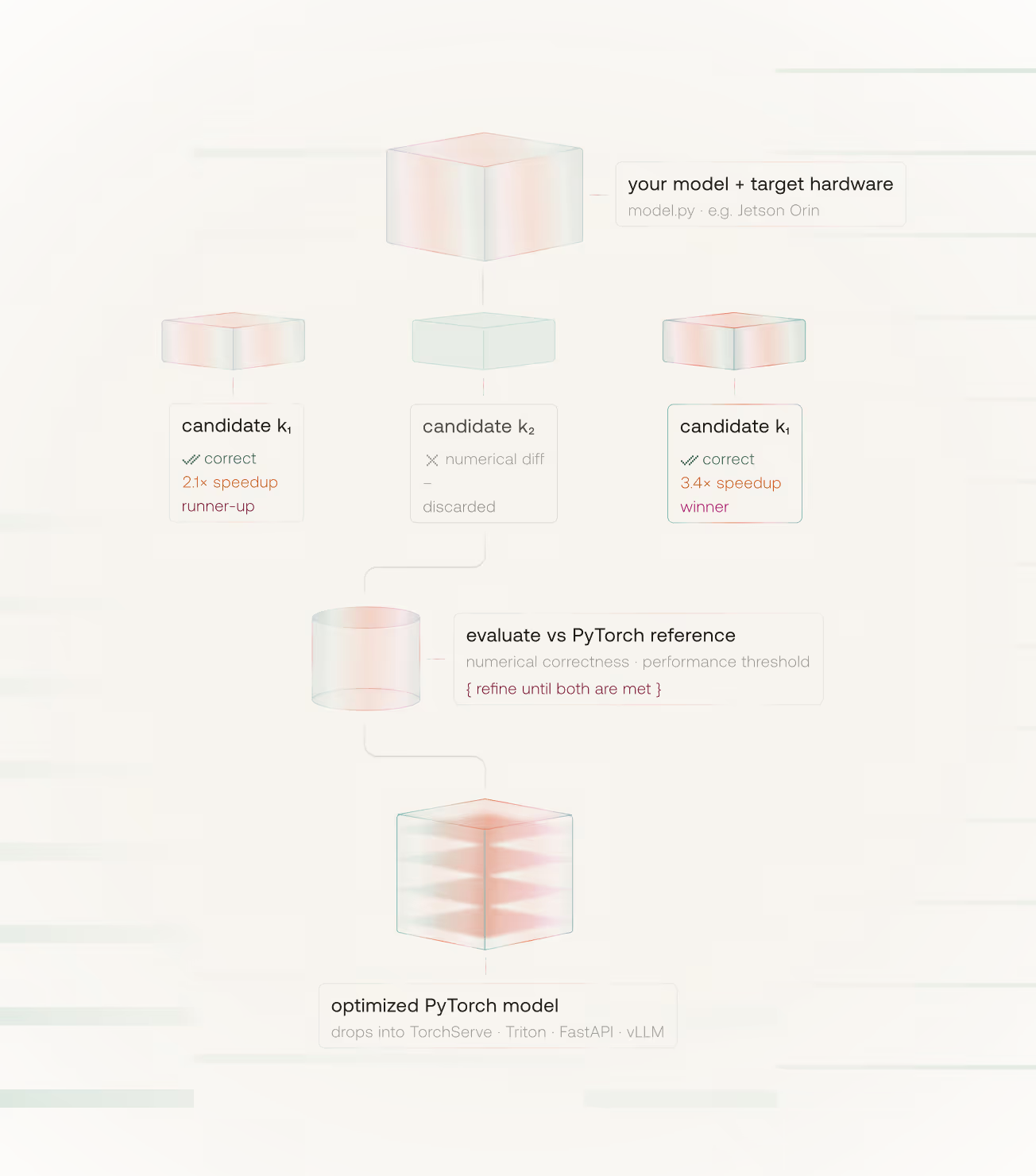
Agents profile your model on the target hardware, generate candidate kernels, evaluate them numerically against the PyTorch reference, and refine until correctness and performance thresholds are met. Output: an optimized PyTorch model that drops into TorchServe, Triton, FastAPI, or any PyTorch-based serving framework.

Hardware-specific kernel candidates generated autonomously

Numerical correctness validated against PyTorch reference

vLLM integration on roadmap

Read the docs
Read the docs

yasp.native

Hardware-native binaries for any silicon.

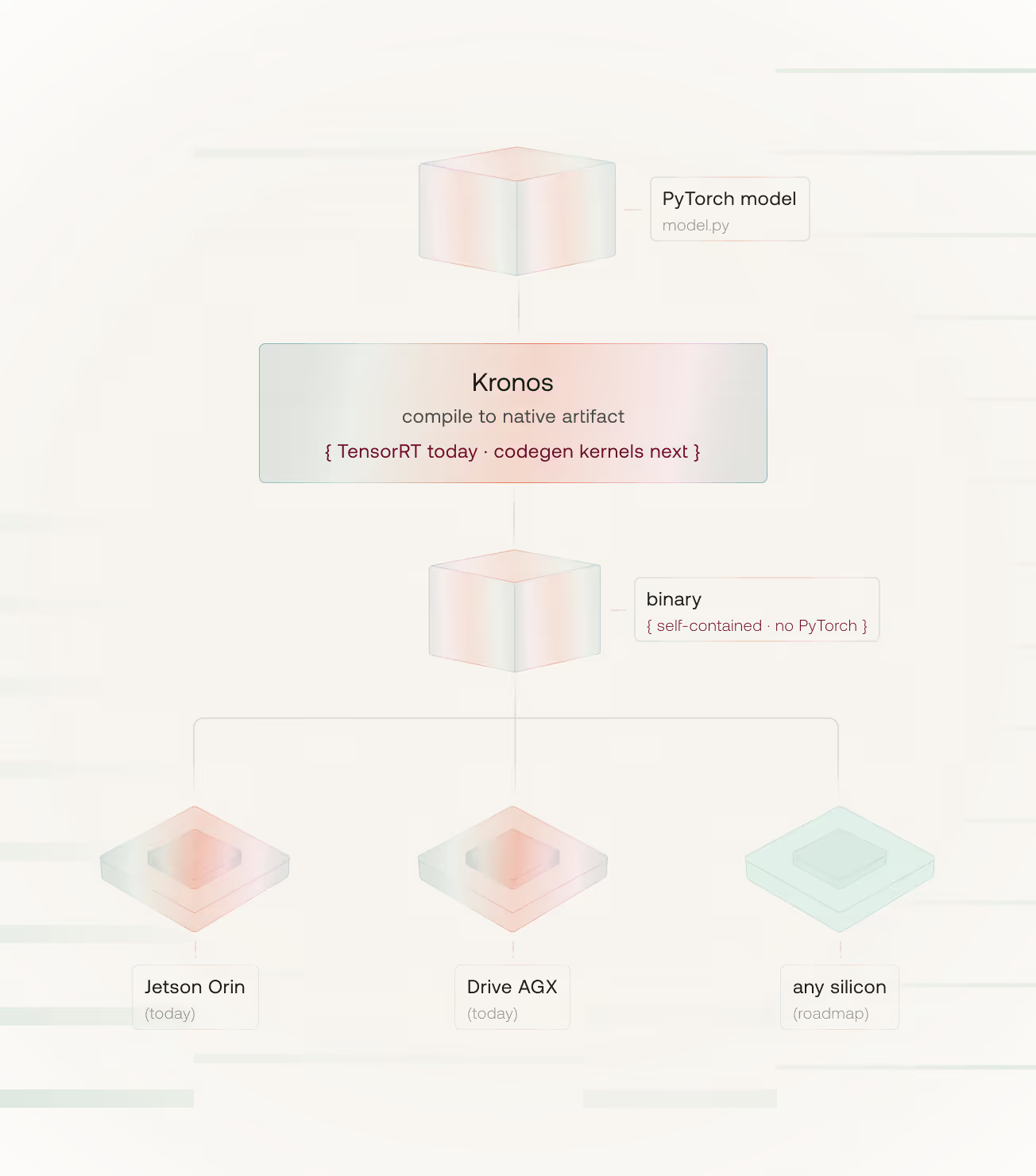
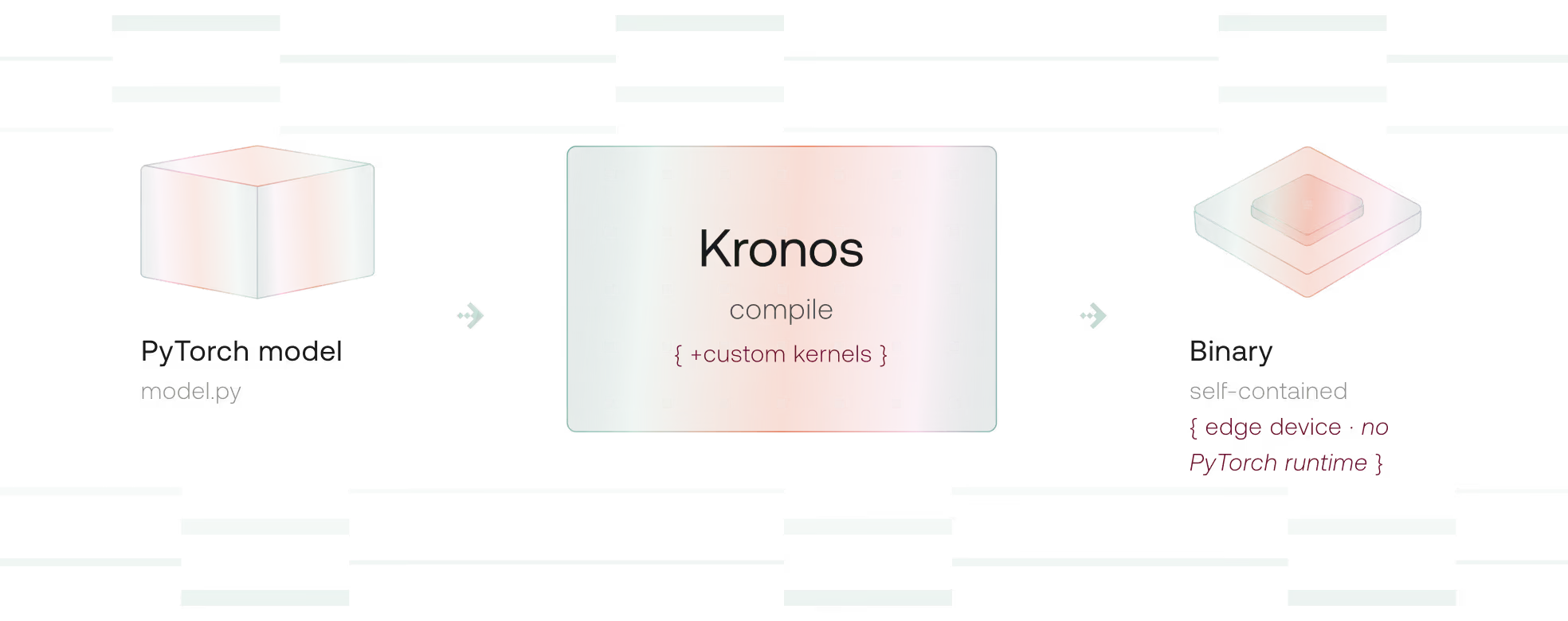
When PyTorch isn't welcome in production, yasp.native ships a self-contained artifact. TensorRT engines for Jetson Orin and Drive AGX today. Vendor-agnostic binaries with codegen kernels under the hood next. Any CUDA version, any OS, any runtime. Edge, embedded, regulated environments, all covered.

Self-contained, no PyTorch in production

Any CUDA version, OS, or runtime version

Currently optimized for NVIDIA edge: Jetson Orin and Drive AGX

Read the docs
Read the docs

KernelDB

Verified kernels, retrieved instantly.

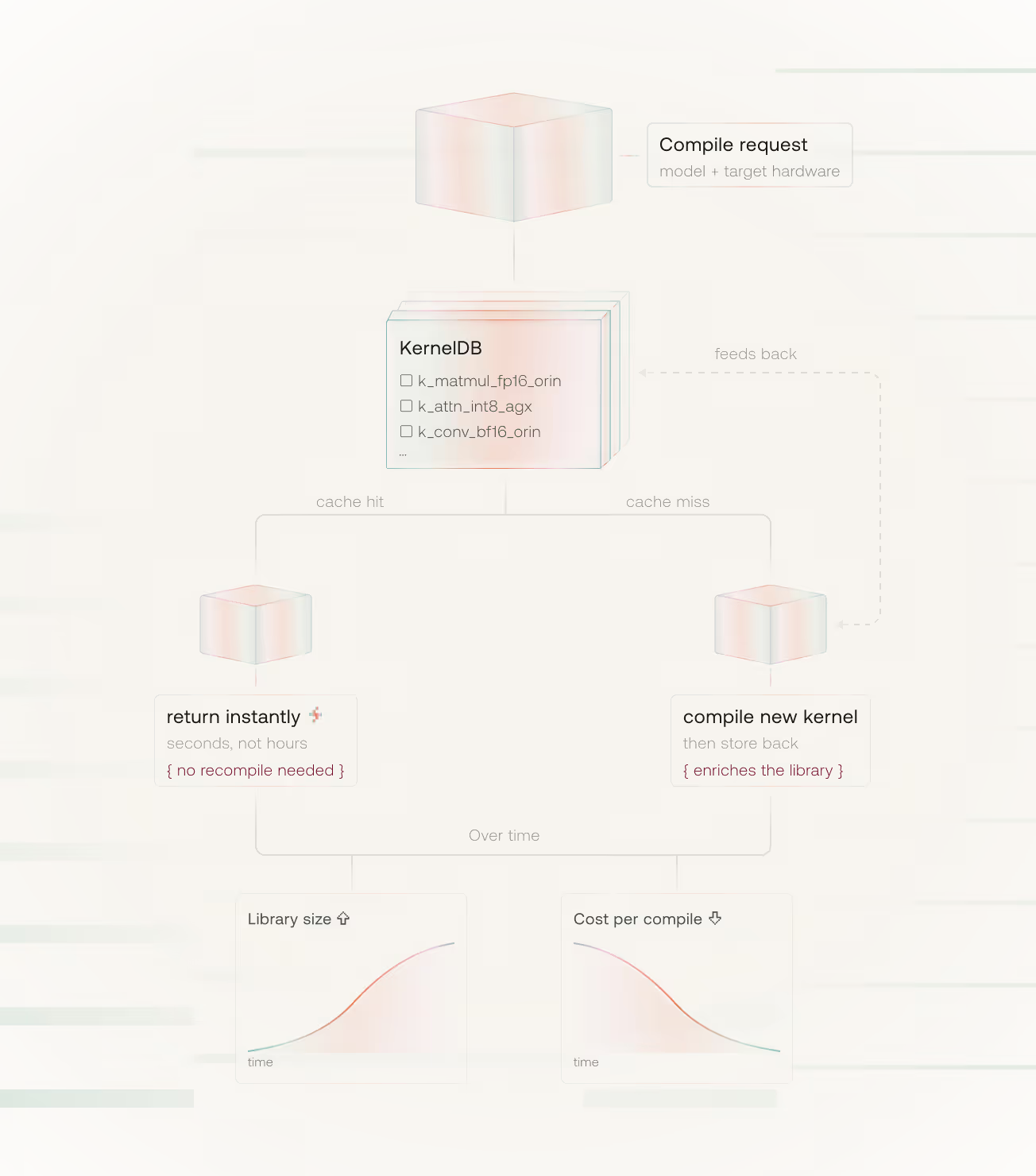
Every verified kernel feeds the next compilation. Future runs on the same hardware hit cache and complete in seconds. The system improves over time as agents are fine-tuned on accumulated results.

Cache hits return in seconds

Every customer's compile enriches the library

Cost per compile drops as the library grows

Book a demo
Book a demo
Read the docs
Read the docs
Platformless AI Infrastructure

Generate. Test. Refine.
Verified output.

yasp's agents don't just write kernels. They compile, run them on the actual target
hardware, measure performance and correctness, and feed the results back into the next iteration. Every kernel you receive is verified, never a suggestion.

Get Started
Get Started
Read the Docs
Read the Docs

One model. Two paths

Path A

Cloud, training, research

Optimized PyTorch.

Drop-in replacement for your existing PyTorch model. Works with TorchServe, Triton,
FastAPl, and any PyTorch-based serving framework. Full PyTorch features available,
including training. Same code, faster execution, identical outputs..

Powered by:
Gaia

Path B

Edge, embedded, production

Hardware-native binary.

Self-contained, no PyTorch in production. Compatible with any CUDA version, OS, or
runtime version. Custom kernels generated for any op TensorRT doesn't support
natively. Currently optimized for NVIDIA edge: Jetson Orin and Drive AGX.

Powered by:
Kronos

Coverage

Every target. Same workflow.

PyTorch in. Hardware-optimized output. Vendor and architecture coverage grows every quarter, driven by what customers ship.

Request a target
Request a target
Read the Docs
Read the Docs
Proven on real silicon

No Claims. Just Facts.

AI infrastructure is full of performance claims that are hard to compare and harder to trust. yasp validates generated code and optimization results on real hardware. We earn credibility by making verification easy.

Status quo vs yasp

Why yasp?

The status quo locks teams into single-vendor ecosystems. yasp compiles your model for
the hardware you choose, validates on real silicon, and gets out of the way.

Without yasp?

Locked into one vendor's stack.

The vendor's ecosystem dictates which chips you target. Switching costs months of re-engineering.

Kernel engineering is scarce and expensive.

Optimizing for non-default hardware requires compiler engineers most teams can't hire.

Static tools leave gains on the table.

Traditional compilers produce code deterministically. They don't adapt —
performance is left on the table.

Edge needs separate engineering.

Models that work in the cloud need painful re-engineering for edge devices. Edge stays theoretical.

With yasp?

Change the target. Recompile.

yasp optimizes for the chip you specify. Change the target? Recompile. No new
toolkit.

Agents generate optimized kernels autonomously.

Not lowest common denominator - performance tuned specifically for the target you chose.

Agents adapt to your model and target.

yasp's compiler learns from every compilation. The search space is too large to hardcode — so yasp uses Al to navigate it.

Same workflow, cloud or edge.

Compile for cloud and edge from the same model. Pre-built images pushed to
devices.

Technical questions. Honest answers.

For company and business FAQs, see the homepage.

No items found.
Thank you! Your submission has been received!
Oops! Something went wrong while submitting the form.

Every kernel is validated against the PyTorch reference within strict tolerances. Validation results are included with every compilation and surfaced in the agent's output. If a candidate kernel doesn't meet the threshold, the system iterates until it does, or falls back to the reference implementation.

All topics
Product

yasp traces through standard PyTorch and third-party libraries. Novel layers like Mamba are supported. Operations that can't be optimized fall back to the reference implementation, so correctness is never compromised by ambition.

All topics
Product

Cache hits via KernelDB are near-instant. First-time compilations depend on complexity: the agents may explore for up to 30 minutes on a fresh model as they generate and validate candidate kernels. Subsequent runs on the same hardware return in seconds.

All topics
Product

Yes. yasp supports lower-precision execution (FP16, BF16, INT8) when the target hardware benefits and your accuracy thresholds allow it. The main focus is kernel generation and hardware-specific optimization, where the largest gains usually come from.

All topics
Product

yasp operates on the mathematical graph of your nn.Module. Model weights stay in your environment and are never transmitted. KernelDB stores verified kernels and performance profiles, not your architecture or training data.

All topics
Product

No. Whether you ship optimized PyTorch via yasp.codegen or a hardware-native binary via yasp.native, the output is self-contained. No SDK, no runtime, no persistent layer. Deploy anywhere the target hardware is available.

All topics
Product